
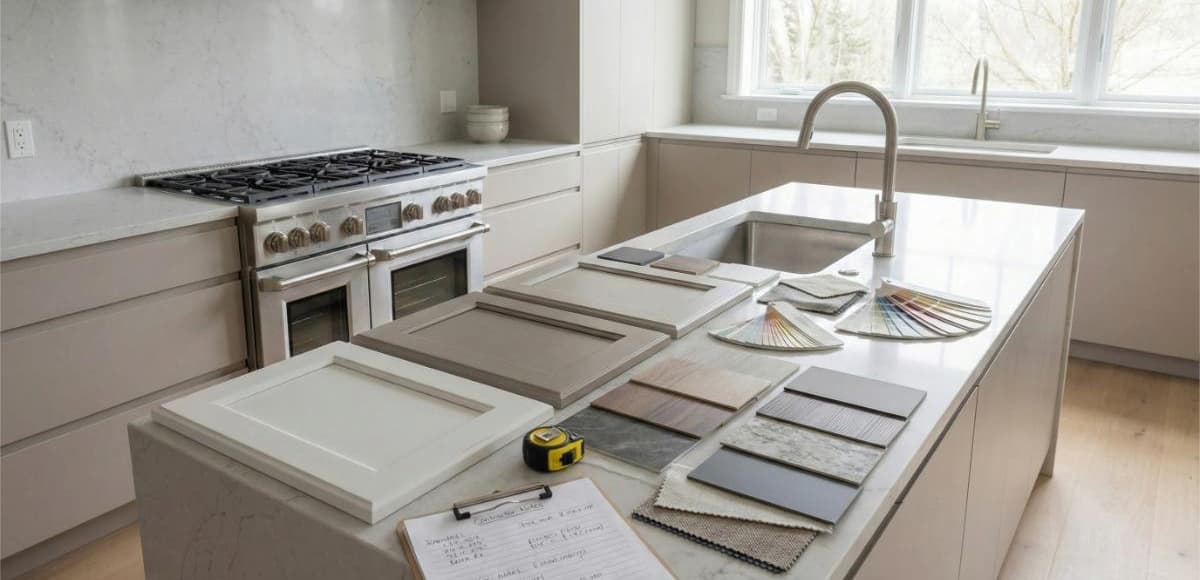
Kitchen cabinets are entering a finish-first era. As material costs rise and remodel timelines stretch, more homeowners are upgrading surfaces instead of ripping out boxes. If you’ve been searching “painting contractors near me” and keep seeing “flow wrap” or “vinyl wrap cabinets,” here’s the answer upfront: flow wrap cabinets are cabinet doors or panels covered in a thin PVC vinyl film that’s heat-bonded and vacuum-pressed over a rigid core, most commonly MDF. The wrap creates a smooth, uniform face and a nearly seamless edge, a popular look in today’s flat-panel kitchens.
✔ Flow wrap cabinets are PVC vinyl films bonded over a core, often MDF, in a heated vacuum process
✔ Vinyl wrap cabinets look seamless, but heat and steam can weaken the bond and cause peeling
✔ MDF can swell if moisture gets under a lifted edge, which can permanently distort a door
✔ Painted cabinets are usually easier to touch up and change later
✔ Choose wraps for speed and uniformity, choose paint for repairability and future color changes
“Flow wrap” is often used as a catch-all term for factory-applied cabinet wrapping, including thermofoil and other vinyl membrane finishes. You’ll also hear cabinet wrap, cabinet vinyl wrap, vinyl for cabinets, kitchen cabinet wraps, or kitchen cabinet vinyl wrap. The defining trait is the one-piece look: faces and edges are wrapped so seams are minimal, which is why these doors look so uniform in showrooms. A knowledgeable kitchen remodel contractor can help homeowners determine whether wrapped cabinet finishes are the right choice based on durability, maintenance requirements, and overall design goals.
Most vinyl wrap cabinets start with medium-density fiberboard because it’s flat and easy to machine into modern profiles. A thin PVC film is placed over the door, then heated and pulled tight in a vacuum press so it fuses to the substrate.
That manufacturing detail matters: the finish is bonded, not built up in layers like paint. If the film lifts, you typically can’t sand and blend a seamless repair the way you can with cabinet paint.
Vinyl wrap cabinets can be a strong match for homeowners who want crisp, modern doors and a uniform finish across every panel consistently.

Vinyl wrap cabinets have two practical weak points: the bond and the core. The bond can loosen with sustained heat or repeated steam, and the film can lift or peel at corners or near appliances once it starts to fail.
The core matters because many wrapped doors use MDF, and MDF can swell when water gets underneath the film at a failed edge or damaged spot. Once the substrate swells, the door rarely returns to flat. Peeling is common and may be addressed by re-adhering small areas or replacing the door when damage is extensive. If you’re set on vinyl wrap for cabinets, ask about heat shields near ovens and the warranty language around delamination.
Vinyl wrap cabinets and painted cabinets can both deliver a clean, modern look, but they age differently.
If you expect to change colors later, paint keeps your options open. If you want a factory-uniform surface now and you’re confident about moisture and ventilation, cabinet vinyl wrap can deliver that look quickly.

Flow wrap cabinets are a strong option when your goal is a fast, uniform update and your kitchen conditions are friendly to vinyl.
Choose a different finish when your kitchen is hard on materials.
Westport kitchens see real-life wear: wet coats, busy mornings, and cooking that pushes humidity and heat. If you want a factory-smooth look and your kitchen stays dry and well-ventilated, kitchen cabinet wraps can be a practical refacing choice.
If your priority is long-term flexibility, easy repairs, and custom color, painting is often the better investment, especially when you want to match nearby trim or refresh the color years later.
If your home was built before 1978 and the work will disturb old coatings, ask any contractor about lead-safe practices and certification requirements.

If you’re deciding between cabinet wrap and paint, an on-site evaluation can save you from choosing a finish that doesn’t match how you cook and clean. Westport Professional House Painters serves Westport, CT, and can help you assess door condition, heat and moisture exposure, and the most practical path to a durable finish. If you’re comparing painting contractors near me, ask specifically about cabinet prep, adhesion methods, and curing time, because those steps determine whether cabinets look great for years, not months, locally.